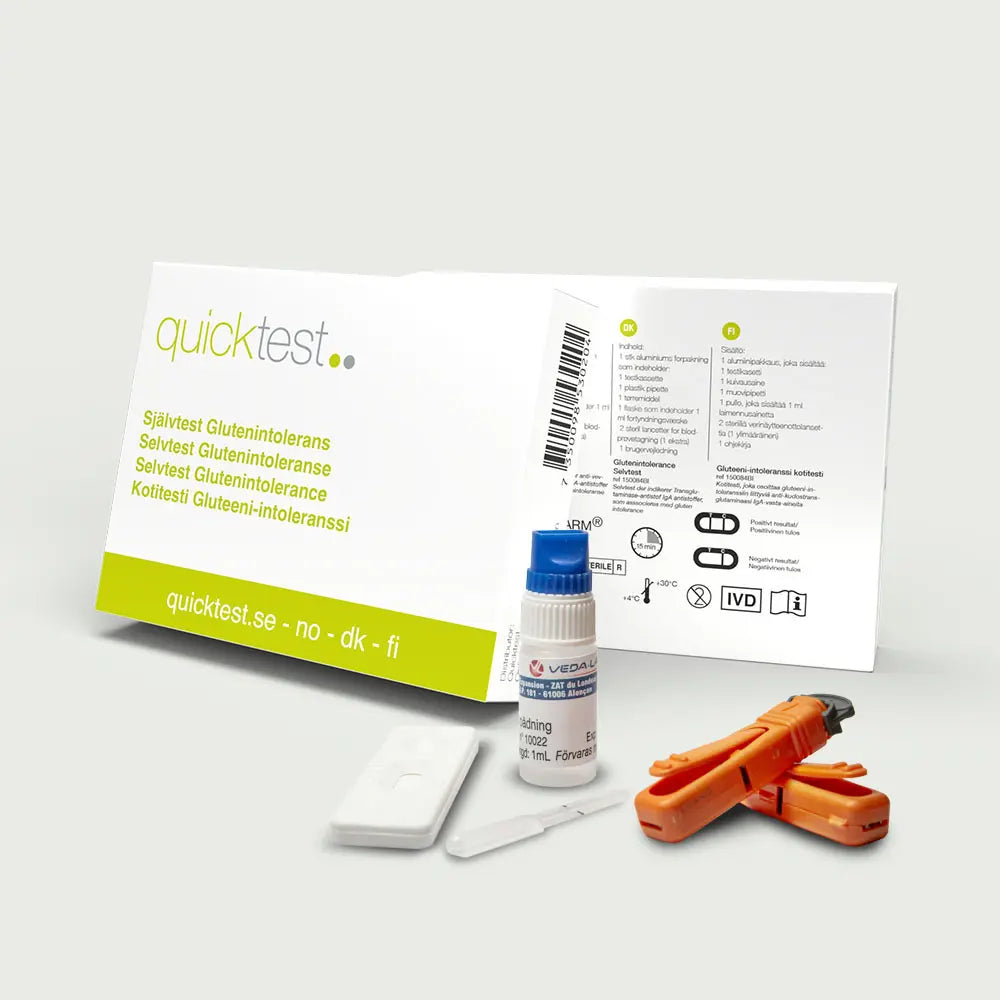
Gluten test
Self-test
Blood You perform the test yourself and receive the result immediately.

Gluten test

169 SEK
  • Test för celiaki (glutenintolerans)
  • Enkel provtagning hemma
  • Svar på 15min
  • CE-märkt

Vårt Glutentest upptäcker IgA-antikroppar som är direkt associerade med celiaki/glutenintolerans.

En oupptäckt glutenintolerans kan orsaka skada på tarmluddet i tunntarmen, vilket ger ett sämre upptag av olika näringsämnen och kan leda till näringsbrist och ohälsa. Om vårt test visar positivt betyder det att finns en god anledning till att uppsöka läkare för vidare undersökning och diagnostisering.

Buy more, save more

Payment methods
  • Klarna
  • Visa
  • Mastercard
  • American Express
  • Apple Pay
  • Google Pay
In stock and ready to ship

Test at a glance

Take the test at home and get a clear result immediately.

Test type
Self-test
Sample
Blood
Results within
15 min
Reliability
97%

Test for Celiac Disease/Gluten Intolerance at Home

Gluten intolerance, also called celiac disease, is a chronic inflammatory disease that means you cannot tolerate the protein gluten. Common symptoms include stomach upset, fatigue, and weight loss. With Quicktest Gluten test you can find out if you suffer from gluten intolerance. Our gluten test comes with a home testing kit and is done by taking blood from a fingertip prick. In gluten intolerance Elevated levels of IgA antibodies against tissue transglutaminase are most often seen. Our gluten test indicates anti-tissue transglutaminase IgA antibodies in the blood. Note: If you have excluded gluten from your diet when taking the test, eat a gluten-free diet, there is a risk that the test result will be negative even though gluten intolerance is present. If you eat a gluten-free diet, it is recommended to eat at least one meal a day for 14 days before taking the test to get a more reliable test result.

What does gluten intolerance mean?

At Celiac disease, also called Gluten intolerance, the body's immune system is activated when you eat gluten and attacks the gluten in the intestine. When gluten proteins, which are found in wheat, rye and barley, reach the small intestine, an autoimmune reaction is triggered. This causes the immune system to attack the villi on the lining of the small intestine, which becomes inflamed. If the small intestine is exposed to gluten for a long time, the inflammation becomes so severe that the intestine has difficulty absorbing nutrients. The body then suffers from nutritional deficiencies. Untreated celiac disease therefore increases the risk of complications such as iron, vitamin and trace metal deficiencies.. Gluten intolerance/celiac disease can affect both children and adults. The disease occurs and debuts in all age groups, young and old. Today it is estimated that almost three percent of the Swedish population suffers from celiac disease and at the same time an increase is seen in society. Currently, the only treatment for gluten intolerance is a strict gluten-free diet.

Common symptoms of gluten intolerance?

The most common symptom of gluten intolerance is stomach discomfort such as gas, diarrhea, bloating, constipation, weight loss, and nausea. But celiac disease can also cause other symptoms, which may not be as obvious, and they can vary greatly between different people. Diffuse symptoms may include fatigue, depression, mouth blisters, skin rashes/eczema, and joint and bone pain. In some cases, symptoms of gluten intolerance can also manifest themselves in delayed growth in children. Publication information Fact-checked 2025-02-07 by Leg Doctor Fredrik Lönnqvist Leg Nurse

What is analysed

  • t-TG of IgA type

How it works

From sample collection to a clear result – every step is designed to be simple.
01

Open the test

02

Collect the blood sample

03

Start the test

04

Read your result

Video

Frequently asked questions

Why should I test for gluten intolerance?
Gluten intolerance (celiac disease) is a chronic autoimmune disease that affects the small intestine and therefore also the body's absorption of nutrients. Untreated celiac disease increases the risk of complications including iron, vitamin and trace mineral deficiencies. Living with untreated gluten intolerance often has a major impact on quality of life, but by changing their diet, people affected can significantly improve their daily lives.
Does a positive gluten test mean that I have a gluten allergy?
No. Celiac disease should not be confused with an allergy, such as wheat allergy, where symptoms can be severe. If you have celiac disease/gluten intolerance, the body reacts to proteins found in wheat, rye and barley. This damages the intestine and can lead to nutrient deficiencies. In cereal allergies, wheat is usually the grain that is not tolerated. 
Is celiac disease hereditary?
Celiac disease is hereditary to some extent, which means that people who have a close relative with celiac disease are at higher risk of developing the condition. The risk of developing celiac disease is around 15 percent if someone else in the family has the disease.
Can you grow out of celiac disease?
Celiac disease is a chronic condition that does not disappear with age in the way many food allergies can. It is common for a person's symptoms after consuming gluten to vary over their lifetime.
Is low iron common when you have celiac disease?
With untreated celiac disease, iron deficiency can be common because an intestine exposed to gluten for a prolonged period can become so inflamed that it has difficulty absorbing nutrients. The body can then develop nutritional deficiencies, including iron deficiency. 
Portrait

Home testing made simple

Quicktest brings together self-tests and home sampling tests in one place. Clear instructions, discreet delivery and easy-to-understand results help you take the next step with confidence.

Portrait
100.000+
Customers and users
Quality
Carefully selected tests
Europe
Delivery across Europe
Support
Help choosing the right test
Gluten test